Wednesday, October 7, 2015

Project 6 — Multivocal Poetics


To begin, let me say I have nothing against monophony. As humans it's the fundamental limit placed upon our otherwise very versatile vocal instrument, and even as a musician I started out on a monophonic instrument (the alto saxophone) and find myself predominately drawn to them (electric bass, analogue synthesizers) to this day. Likewise, while the predominate lyrical impulse in poetry is towards a singular perspective, and the linearity of reading locks us into monolexical mode, that doesn't mean that we can't benefit from injecting a little polyphony into our poetic practice. In fact, a number of you already did this to tremendous effect in your responses to prompt #2.

So for this project, I'd like you to make an audiotext that's in some way multivocal. There are a number of different ways in which you might pursue this and I'll outline them below.

At the most basic level you might opt to perform a poem and then multitrack a second (and third, etc.) recording of the same text. Double-tracking is a very common technique producers use to beef up vocals in particular. Despite one's best efforts towards perfectly matching pacing, emphasis, etc. it's inevitable that variations will occur and these produce a signal that's both denser and modulated (this basic chorus effect is why orchestras have string sections and not just one violin, one viola, etc.). Here's a brief example of John Lennon's double-tracked vocals from an early Beatles track for example:


You might choose to write and then perform a text that involves multiple voices and/or perspectives in such a way that each voice is separate and non-overlapping — if you do this you might even want to cast other voices. The works that some of you produced for prompt #2 would fit this mode well.

Finally, you might choose to write and perform a text that plays around with simultaneity (some examples below): that is, a text that can't necessarily be read in full on its own by one person, but which, in audio form and via multitrack recording, can be experienced as intended.

A few contextual examples for you to browse at your leisure:
  • John Ashbery's 1979 long poem "Litany" begins with these instructions: "The two columns of 'Litany' are meant to be read as simultaneous but independent monologues." That's impossible to do on the page, a 1980 studio recording featuring Ashbery reading the left column in the left channel and poet Ann Lauterbach the right in the right channel, allows us to experience it as intended. —  "Litany," Part One [PDFMP3]
  • Charles Bernstein's 1976 tapework "Piffle (Breathing)" [MP3] features simultaneous spontaneous dialogues between the poet, Greg Ball and Susan Bee Bernstein. Jumping forward to 2003 we can listen to a  two-voice rendition of his poem "War Stories" featuring his daughter, Emma [poem and MP3 here]
  • John Giorno's early poetry was based on appropriation of found texts. By the late 1960s he'd moved on to manipulate these source materials in a staggered two-column format approximating stereo channels, as seen in poems like "Johnny Guitar" [PDF]. In the live setting poems like this were performed with the help of pre-made recordings and tape delay systems, as you can hear in this recording of "I Don't Need It, I Don't Want It, and You Cheated Me Out Of It."
  • Hannah Weiner's clairvoyantly-derived writings — in part originating in her schizophrenia, through which she experienced aural and visual hallucinations of words and phrases that she transcribed into poetry — required a unique style of layout, making use of all-caps text and italics, along with super- and sub-scripts. You can listen to a live multi-voice performance from 1978 and read along with the text [MP3, text begins here with the complete work here
  • Listen, a 1972 radio play written by Robert Creeley, and performed by Robert and Bobbie Creeley, was released on cassette by Black Sparrow Press in 1972 — Listen (23:09): MP3
  • Susan Howe and David Grubbs' 2005 CD release Thiefth features complex performances of two of Howe's historical investigations — "Thorow" [PDF] and "Melville's Marginalia" [excerpt: PDF] — with musical accompaniment and voice manipulation (via the MAX/MSP software) by Grubbs. You can listen to the tracks and read the record's liner notes on PennSound's Howe/Grubbs author page, where you'll also find later collaborations.
  • The Velvet Underground's infamous "The Murder Mystery" (taken from their self-titled 1969 album), exploits the stereo medium with Lou Reed and guitarist Sterling Morrison reading separate competing lyrics in the left and right channels during the verses, with drummer Maureen Tucker and bass/keyboard player Doug Yule trading off overlapping vocals on the choruses.  Reed would later publish a version of the lyrics in The Paris Review in 1972, but this version comes from his collected lyrics, Between Thought and Expression: [PDF]

Your responses to this prompt should be in audio format (either MP3 or SoundCloud link) of a reasonable length and should be e-mailed out no later than Saturday, October 17th. We'll begin workshopping these pieces when we return from the fall reading days on the week of the 19th.

Friday, October 2, 2015

Project 5 Workshops — Oct. 9–14

Here's the random schedule for the fifth round of workshops — focusing on the poems you wrote in response to Project 5: Improvise and Excise — which will take us up to the fall reading days (and a well deserved break):
Please send out your work in Word format to the list by the time of our class meeting on Wednesday, October 7th, and make sure your comments on your peers' work is sent to them (and me) in advance of each workshop meeting.

Sunday, September 27, 2015

Project 4 Workshops — Oct. 5–7

I fired up the list randomizer again and here's our schedule for the fourth mini-round of workshops, focusing on the 30-second loop pieces you made in response to Project 4: Micro-Loops:


Please send out your work — either as attached MP3 files or a SoundCloud link — to me and me alone no later than the end of the evening on Saturday October 3rd. As I mentioned in the prompt itself, you won't be writing responses in advance for this project. Instead we'll respond on the fly in class, and we should have a little time left on Wednesday for general comments on this round.

Wednesday, September 23, 2015

Project 3 Workshops — Sept. 28 – Oct. 2

Here's our randomized schedule for the third round of workshops, focusing on the audiotexts you made in response to Project 3: Constrained Cut-Ups


Please send out your work — either as attached MP3 files or a SoundCloud link — to the list by the time of our class meeting on this Friday, September 25th. As I mentioned in class today, you won't be able to do line-by-line comments but do send your peers a short note (either in a Word doc or just an e-mail message) with your feedback on their pieces. Some things in particular that you might want to focus on: sound, semantics, and technique.

Sunday, September 20, 2015

Project 5: Improvise and Excise

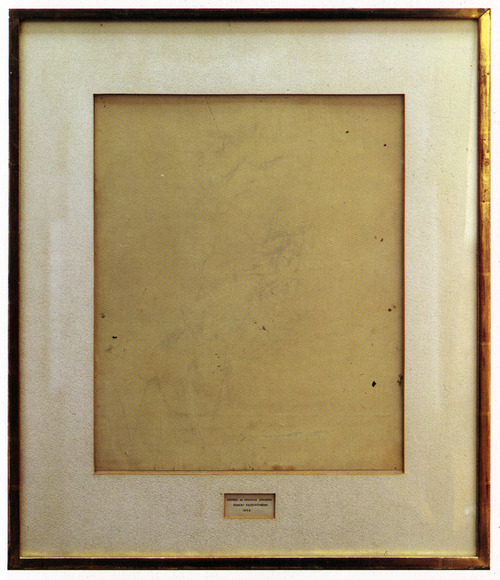
Robert Rauschenberg's "Erased de Kooning Drawing" (1953)
For our next project, we'll be working with two parallel forces — creation and destruction — to produce a finished poem.

The first step will involve making a short recording of improvised speech (or singing, or freestyling — basically you making words however you'd like), which you'll then process. Ninety seconds might be an ideal length but feel free to do more or less as you prefer. In any case, set the time frame and stick to it.

You should only record one take and fill that time with as much or as little speech as you'd like. Perhaps you'll try to work out a new poem you haven't yet written or recall an old one from memory; maybe you'll make a to-do list or tell a story, talk to a friend, talk to yourself, string together stream-of-consciousness associations, or make one straightforward statement. In any case, once you're done, transcribe what you've recorded. 

Now the second step of the project commences. Using your complete transcription as a source text that you'll break down via the process of erasure to yield a final text, not unlike how a sculptor begins with a block of marble and chips it away a little bit at a time to create their finished piece. You can cut as much or as little as you'd like, and can remove words in complete units (i.e. clauses, sentences, paragraphs) or individual words (or even letters). That is to say that your final piece will be as cohesive (or deconstructive) as you want it to be. You might choose to work in Word itself, deleting text as you desire, or with a print-out of the document, using a Sharpie, Wite-out, scissors, drops of paint, etc. and then retranscribe the results into Word.

Before we get to specifications for this assignment, a few precedents and contexts: Wave Poetry is a publisher with a serious interest in the erasure technique and they've gone so far as to produce an erasure engine that allows visitors to make their own texts from sources as diverse as Melville's Moby Dick, Kant's The Critique of Practical Reasoning, and Aristophanes' The Clouds. Other poets using this technique include Joseph Massey and Mary Ruefele, and one of the ur-texts in this genre is Tom Phillips' A Humument — a book-length text created by "treating" a Victorian novel, A Human Document.  As for improvisation and transcription, those techniques are at the heart of poet David Antin's practice: his published works begin as spontaneously-generated talks in various locations, which are recorded, transcribed, and lightly-edited to yield their final versions.

Your responses to this prompt should be written texts texts (ideally in Word format) of a reasonable length (~1 page) and should be e-mailed out no later than our class meeting on Monday, October 5th. If our class stays on schedule, we should be workshopping these pieces from October 9–14, taking us up to the fall reading days.

Project 4: Micro-Loops


Our fourth project builds upon its predecessor and will work a little different than our usual prompts, but more on that in a moment . . .

Repetition is a technique at the very heart of poetic practice: from the strict patterns of rhythm and rhyme found in traditional verse to devices like litany and alliteration. For this mini-prompt, we'll be taking repetition to absurd lengths via technological means.

I'd like you to construct a 30 second audiotext that involves looping as its constitutional technique. While the length is absolute, all other details are open: you can use found sound or record your own audio, and you can select a loop of any length — it might be a five second sample that loops six times, half a second that loops sixty times, etc. and your loop need not begin and end cleanly, either.
"You know what's an excellent word to say out loud repeatedly?" Nicole Bonner chewed her hair. " 'Rinse.' Think about it, Mr. Kerchek. Rinse. Rinse."
— David Schickler, "The Smoker"
The point here, perhaps, is to find a new sort of beauty in language when we divorce ourselves from our usual relationship with it, achieving something not unlike a reduced reaction to semantic information (as in the example above). Or maybe what you'll find will be more semantic à la the potential for truths being revealed through the cut-up process (as Burroughs suggests). Also, while you'll be working in audio, there are textual precedents for this sort of experiment: cf. Ron Padgett's "Nothing in That Drawer," "Sonnet for Andy Warhol" and Two Stories for Andy Warhol (n.b. the detail shown on the linked page is one of ten identical pages from Padgett's book), or Aram Saroyan's minimalist work: [1] [2] [3] [4] [5] [6]

You can set up loops pretty easily in both Audacity (highlight a portion of the waveform and hold down shift as you hit the space bar to start loop play mode) and Garageband (use the loop button in the toolbar with play, stop, etc. and set your loop area by dragging the edges of the yellow bar above the waveform) and you'll likely want to fine-tune your loops points before cutting and pasting your final product together. Likewise you'll probably want to make a number of these constructs — which can be pretty quickly thrown together — before deciding on the one that you want to present in workshop.

Your responses to this prompt should be in MP3 format — either as a SoundCloud link or an e-mail attachment — and should be exactly 30 seconds long. Please send your pieces to me (and me alone) by our class time on Friday, October 2nd. We'll go over these pieces in class on the 5th and 7th of October in a randomized order and you'll be encountering them for the first time in class, so you won't be writing comments ahead of time. You should, however, come prepared to discuss your peers' work on the fly.

Tuesday, September 15, 2015

Project 2 Workshops — Sept. 21–25

I ran the class roll through the randomizer again and here's the schedule we got for our second round of workshops, focusing on poems written in response to Project 2: Surveillance Poetics:
  • Monday, Sept. 21: Edgar, Baxter, Hoffman
  • Wednesday, Sept. 23: Haig, Pieper, Roller
  • Friday, Sept. 25: Nelson, Scheifele, Hardcastle

Please send out your poems to the list no later than our class meeting on Friday, September 18th.

Also I wanted to jot down a few reminders on responses coming out of our first round of workshopping:
  • You should be making specific comments on certain lines, words, phrases, etc. using the comments function in Word. If you're not using Word or a program with similar functionality, please add numbered references in brackets and make end note-like comments at the bottom of the document. These can be in-the-moment reactions to these elements as you read them.
  • You should also write some sort of narrative response to the poem at the bottom of the page. In contrast to the in-the-moment comments this provides you with a chance to reflect on the poem after reading it in its entirety.
  • Comments should, above all, be constructive and respectful — which doesn't mean that you can't disagree with the choices the poet made, just that you shouldn't be a jerk about it — and should be substantive. Empty praise doesn't help the poet, nor do vague comments: back up your claims with rationale; explain the effects their choices have upon you as a reader. "I don't understand this" is a cop out as well — make your best effort to absorb the poem and report on the impressions that you do get.
  • Proposing alternatives (to word choices, line breaks, etc.) is a very effective sort of feedback as well. Though it shouldn't be the sum total of your response, playing "if I was writing this poem" is a great approach to take.
N.b. I've posted a shrunk (so as to be somewhat anonymized) screen cap of my comments on Kelly's first poem above. You won't necessarily write that much, but it's something to aim towards. Showing your peers that you care about and respect their work is, first and foremost, being a good workshop citizen. It's also not a bad way to get the same treatment from them as well!